Up to $1.55M with 0% equity — eligibility, Phase I/II amounts, and how to apply for NSF SBIR, checked October 9, 2026
The U.S. government will fund your startup up to $1.55 million and take 0% equity. No, that is not a typo. It is America’s Seed Fund — the NSF SBIR grant program run by the National Science Foundation — and it is open right now.
After a multi-month pause, the NSF SBIR program restarted in May 2026 with $250 million in SBIR funding for U.S. startups building high-risk technology — AI, robotics, biotech, energy, semiconductors, and more. The next full-proposal deadline is November 4, 2026.
There is a catch, and it matters: this is research funding, not free business money. NSF funds technical risk — the chance that a hard engineering problem might fail even when smart people attempt it. If your “startup idea” is reselling products or assembling an app from existing tools, this program is not for you. If you are solving a genuine scientific or engineering problem, keep reading — this NSF SBIR grant guide covers every requirement, dollar amount, and application step.
Tables in this article
- Table 1 — Quick fit check: is your idea research or just business?
- Table 2 — NSF SBIR funding routes, amounts and project periods
- Table 3 — SBIR vs STTR requirements compared
- Table 4 — Project Pitch: the 4 sections and character limits
- Table 5 — NSF SBIR full-proposal deadlines 2026–2027
The 2026 relaunch: are SBIR grants frozen?
No — but they were paused. After a multi-month gap with no active solicitation, NSF announced the NSF SBIR/STTR restart on May 31, 2026, backed by a $250 million FY26 allocation. The Project Pitch portal reopened June 2, 2026, and the first full-proposal deadline under the new solicitation (NSF 26-510) was July 27, 2026.
Unlike some SBIR solicitations that open only once a year, NSF runs multiple deadlines annually. Remaining 2026–2027 deadlines: November 4, 2026, March 4, 2027, and July 7, 2027.
The restart followed the SBIR reauthorization — the enactment of the Small Business Innovation and Economic Security Act. If you heard “SBIR is frozen” earlier this year, that was the pause — the NSF SBIR grant program is running again, with a predictable multi-deadline rhythm founders can plan around.
What NSF startup funding actually supports
America’s Seed Fund powered by NSF includes two programs: Small Business Innovation Research (SBIR) and Small Business Technology Transfer (STTR). Their purpose is to help small businesses turn scientific and engineering discoveries into products with commercial potential. The technology can still be early — it may need substantial research before anyone knows whether it will work reliably. 1 19
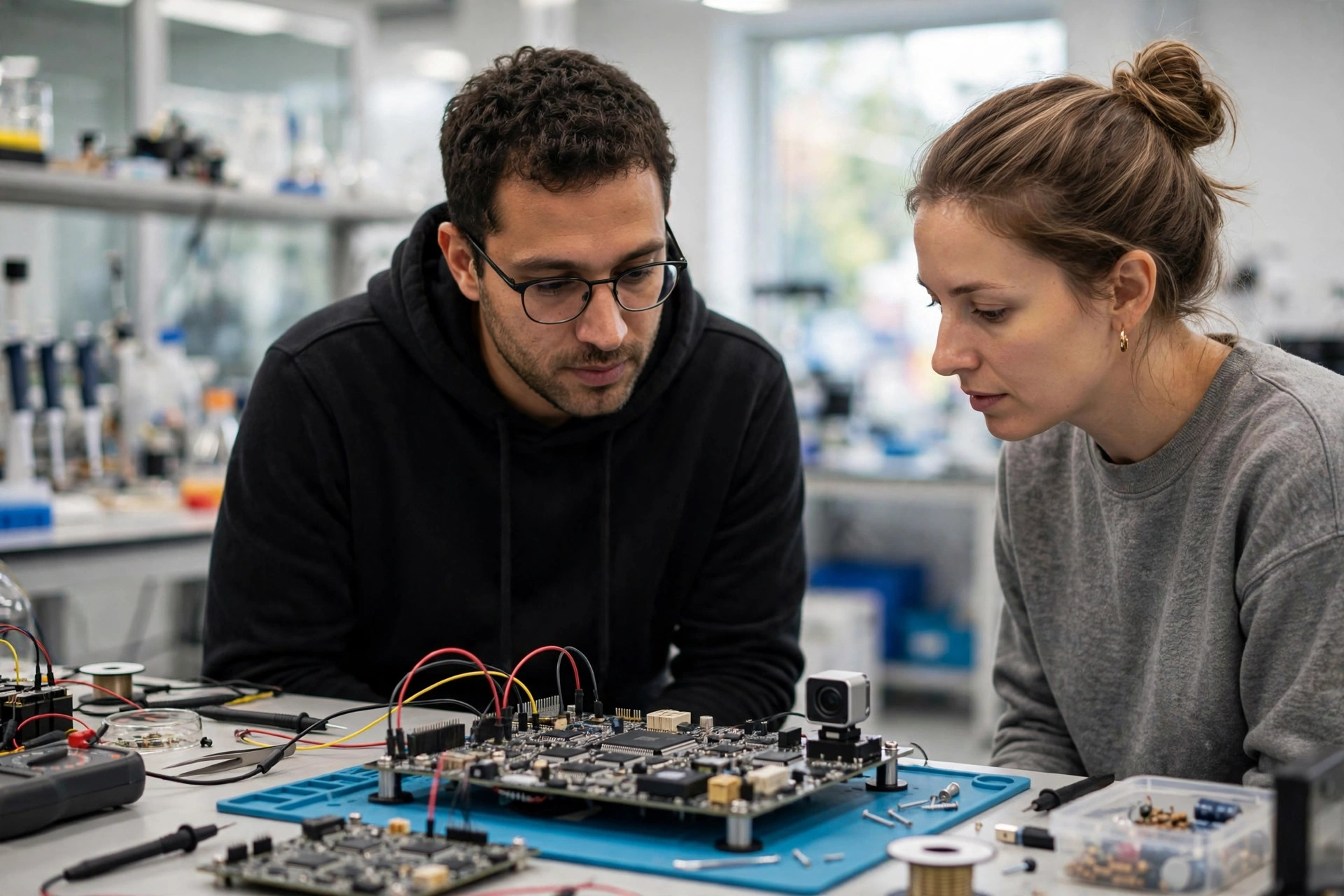
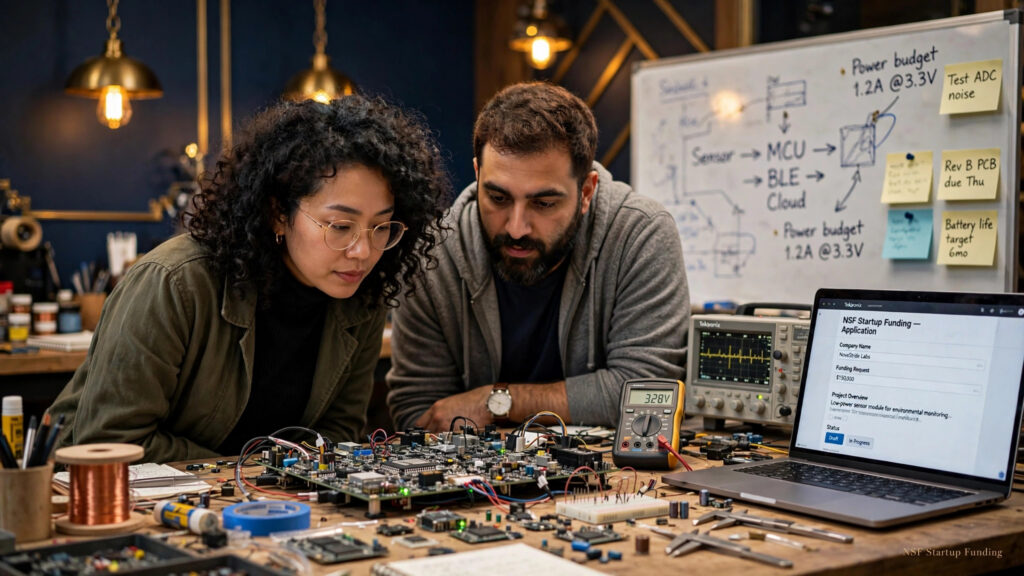
NSF describes technical risk as the possibility that a proposed technological solution could fail even when capable specialists attempt to build it. That is very different from business uncertainty — whether customers will click your ad or whether your store will make sales does not count. 7
The one question to ask yourself: what technical uncertainty must we resolve before our product can deliver something meaningfully better than what exists today?
Quick fit check
These are illustrative comparisons, not eligibility decisions:
| Your business idea | Ask yourself |
|---|---|
| A store reselling existing products | What scientific or engineering problem would the project solve? |
| An app assembled from existing tools | Does it need a new technical method, or mainly implementation? |
| A new water-treatment material | Which experiments would prove performance, durability, feasibility? |
| A new sensor for harsh environments | What unproven capability must be demonstrated under real conditions? |
Covered technology areas are broad: biotechnology, AI, cybersecurity, advanced materials, manufacturing, agtech, quantum, robotics, digital health, and more. But being in a listed sector is only the starting point — NSF’s scope excludes clinical trials and certain activities involving Schedule I controlled substances. 6
NSF SBIR Phase I and Phase II funding amounts
All figures are U.S. dollars — maximum NSF SBIR grant requests or published ceilings, subject to review and available funding. 3 4
| Funding route | Published amount | Project period | Main purpose |
|---|---|---|---|
| Standard Phase I | Up to $305,000 | 6–18 months | Prove technical feasibility |
| Standard Phase II | Up to $1,250,000 | Usually 24 months | Build on Phase I results |
| Fast-Track | ~$1.555 million combined | 6–12 mo Phase I, then 18–24 mo Phase II | Combined proposal for qualifying teams |
NSF SBIR Phase I + Phase II maximums add to $1,555,000 — but that arithmetic does not entitle anyone to both awards. NSF also advertises a pathway of up to about $2 million including supplements; those have their own conditions. 5
Fast-Track splits differently: up to $400,000 for its Phase I component and $1,155,000 for Phase II. It is not an extra award stacked on top of the standard phases. 18
Think of Phase I as a proof of concept stage — can the core technical idea actually work? Phase II then scales up what Phase I proved.
Budget carefully: the current solicitation’s summary lists $1,555,000 for Fast-Track while one sentence in its award section says $1,555,555. The components total $1,555,000. Confirm the exact ceiling with NSF before submitting a budget. 3
How non-dilutive funding affects your ownership
The NSF SBIR grant takes no ownership stake — this SBIR funding comes as grants, not equity investments, and not ordinary loans with principal-and-interest repayment. You keep your company; the award terms govern how you spend, report, and handle intellectual property. 5
Simple example: two founders own 50% each. A non-equity award does not change those percentages. Selling shares to an investor later could. The benefit is room to solve a hard technical problem without giving up equity; the responsibility is using public money for the approved project and meeting every reporting requirement. 17
NSF SBIR grant requirements and Phase I eligibility
A great idea alone is not enough to meet the NSF SBIR grant requirements. Eligibility covers the business, its owners, the research team, and where the work happens:
- Business structure: the applicant must be an eligible for-profit small business. A nonprofit can join as an STTR research partner, but cannot be the applicant. 8
- Ownership and control: the qualifying majority must generally be held and controlled by U.S. citizens, permanent residents, or qualifying U.S.-owned small businesses. A U.S. mailing address alone proves nothing. 8
- Company size: the SBIR/STTR ceiling is 500 employees including affiliates. NSF’s guidance says “fewer than 500” — if you are near the boundary, confirm with NSF first. 7 12
- Research location: funded R&D is generally performed in the United States. Do not assume an overseas exception will be approved. 10
- Technical leadership: the principal investigator must be primarily employed by the small business during the award and legally able to work for it in the U.S. A Ph.D. is not required. 3
NSF also excludes companies majority-owned by venture capital firms, hedge funds, or private-equity firms under its published guidance. Unusual ownership structures need careful review. 9
What this means for founders outside the United States
Founder nationality and company eligibility are different questions. A business operating only from outside the U.S. cannot qualify just because it sells to Americans — and simply forming a U.S. LLC does not satisfy the ownership, control, and research-location rules. International founders must independently meet every applicable requirement. 8 10
SBIR vs STTR: which route fits you?
In the SBIR vs STTR decision, the core difference is how you work with a research institution — STTR (Small Business Technology Transfer) requires one as a formal partner. NSF expresses the rules through budget allocations. 9 10
| Requirement | SBIR | STTR |
|---|---|---|
| Research institution partner | Optional | Required (qualifying nonprofit) |
| Phase I: business share of work | At least two-thirds | At least 40% |
| Phase II: business share of work | At least half | At least 40% |
| Research institution share | Within outsourcing limits | At least 30% |
| Project leadership | Company PI | Company PI + partner co-PI |
Rule of thumb: if you need a university lab to do a substantial part of the research, look at STTR early — including how IP rights will be split. 14
How to apply for NSF SBIR startup funding: 6 steps
The NSF SBIR grant application follows six stages, starting with a short pitch and ending with a full proposal:

Step 1 — Assess your research fit
Start with NSF’s Project Suitability Assessment. Write one plain-language paragraph: your innovation, the unresolved technical problem, and the customer need. Then complete this sentence: “We need to test whether our new approach can achieve ___ under ___ conditions.” If you cannot fill the blanks, you are not ready. 12
Step 2 — Write the NSF Project Pitch
The NSF Project Pitch is not a generic investor deck. NSF requires four written sections with strict character limits: 11
| Pitch section | Max characters | What to explain |
|---|---|---|
| Technology Innovation | 3,500 | The technical advance and how it differs |
| Technical Objectives and Challenges | 3,500 | Research needed and obstacles |
| Market Opportunity | 1,750 | Customer need and competition |
| Company and Team | 1,750 | Expertise and capability gaps |
Describe a testable research plan: the method, the measurement that shows progress, the test conditions. Delete words like “revolutionary” unless you have evidence.
Step 3 — Wait for the invitation (1–2 months)
NSF typically responds to an NSF SBIR pitch in about one to two months. An invitation means you may submit a full proposal — it is not funding. Limits: two pitches per company in 12 months, and three submissions max for the same project/technology. 11
Step 4 — Complete registrations (start early!)
Full proposals require registrations a pitch does not. Do these now — SAM processing can take weeks: 9 13
- SAM.gov — active registration + Unique Entity ID (financial-assistance registration is enough; no contract authority needed)
- Research.gov — register the organization and users for NSF proposal submission
- SBA Company Registry — get the company’s SBIR registry ID
All registrations and the NSF application itself are free. Anyone charging you to “file” these is someone to avoid.
Step 5 — Develop the full proposal
Far more than the pitch: project summary, detailed research description, budget + justification, personnel, facilities, references, and supplements. The Project Description is limited to 15 pages (16 for Fast-Track) — that limit is for that section, not the whole package. Follow the instructions exactly; do not attach unrequested marketing decks. 14
Step 6 — Submit and survive review
Submit your NSF SBIR grant proposal via Research.gov under the correct opportunity. NSF scores intellectual merit, broader impacts, and commercial potential — the research plan’s quality, the team’s capability, the problem’s significance, and realistic market prospects. 15
Final gut-check: can a technically informed stranger identify your experiment, your customer, and why your team can do this work? Keep a copy of everything you submit.
NSF SBIR deadlines: 2026–2027
NSF SBIR grant full proposals are due by 5 p.m. in your organization’s local time. Current NSF SBIR deadlines: 4
| Deadline | Context (as of Oct 9, 2026) |
|---|---|
| November 4, 2026 | Next deadline — 26 days away |
| March 4, 2027 | Following window |
| July 7, 2027 | Subsequent window |

⚠️ Reality check: with 26 days to November 4 and a typical 1–2 month pitch response time, that deadline is only realistic if you already hold an invitation and your registrations are done.
Standard Phase I invitations generally cover the next two deadlines; Fast-Track invitations require submission within four months. Otherwise, aim for March 4, 2027 — and start the pitch now. 3 13 18
When Fast-Track makes sense
The NSF SBIR grant Fast-Track route suits a more prepared team: it requires qualifying research lineage, formal customer-discovery training (like I-Corps), and a complete team — plus the invitation and standard eligibility. Prior SBIR funding alone does not satisfy the lineage requirement. 3 19 17
Do not choose Fast-Track just because the number is bigger. Choose it because you already meet its specific requirements.
What the money can (and cannot) pay for
Allowable: justified research salaries, materials, computer services, qualified technical assistance. The budget must match the project — Phase I restricts equipment purchases, so read the budget instructions before committing to expenses. 10
Not allowable as free spending: ordinary marketing and business-development costs. Commercialization help (TABA, I-Corps) has its own rules and budget categories. 5 10
Payment schedule: Phase I generally releases the award minus $25,000, with the rest after final reports are approved. Phase II pays in installments tied to interim reporting. Your award documents govern the actual schedule. 17
How to write a stronger application
Editorial suggestions for your NSF SBIR grant application, not a scoring formula:
- Name the technical uncertainty before listing product features
- Separate completed research from proposed experiments
- Explain how a successful test changes feasibility
- Name a specific first customer and their problem
- Compare against realistic existing alternatives
- Show who does each research task and how the budget supports it
“We will build a better battery” tells a reviewer nothing. “We will test [material/process], measuring [metric] under [conditions], because [customer reason]” gives them something to evaluate. Every number you cite should come from your own evidence — never invent targets.
Frequently asked questions
What does SBIR stand for? SBIR stands for Small Business Innovation Research — the federal program behind SBIR grants for small businesses. STTR stands for Small Business Technology Transfer — the sibling program that requires partnering with a nonprofit research institution.
Are SBIR grants frozen? Not anymore. The NSF SBIR grant program was paused for several months, then restarted on May 31, 2026 with $250 million in FY26 funding. The pitch portal reopened June 2, 2026 and deadlines are scheduled through 2027.
Is the funding guaranteed? No. NSF reports historical Phase I funding rates of roughly 10–20%. That is a historical proposal rate, not your personal odds. 16
Can a brand-new startup apply? Potentially. NSF says many funded companies are recently formed, small, and new to government funding — but you must still show a real research project and meet every eligibility rule. 5
Can an AI startup apply? Potentially. AI is a covered technology area, but you need a genuine technical innovation and research effort — simply calling an existing AI API is not a research breakthrough. If you’re building with AI, our AI automation tools guide covers practical tools for small teams. 1 11
Does an invitation mean I am funded? No. It means you may submit a full proposal for review. The funding decision comes months later. 12
Can I apply directly for Phase II? Standard Phase II is only for NSF Phase I awardees. Fast-Track is the separate route with its own entry requirements. 19 18
Do I need a Ph.D.? No. NSF does not require the principal investigator to hold a doctorate — the team must simply be capable of the technical work. 3
Where do I start? At seedfund.nsf.gov — take the suitability assessment, read the current solicitation, and prepare the Project Pitch if you fit. 1 12
This article is general information about startup funding, not legal or financial advice. Official NSF and SBA requirements — and your individual award terms — govern eligibility and use of funds. Information checked October 9, 2026.
Keep exploring
Building something of your own? Browse NoviraLane’s Business Ideas and Side Hustles sections for more practical ways to earn.
Official sources
- NSF America’s Seed Fund homepage
- NSF critical information and reopening notice
- NSF 26-510 current program solicitation
- NSF funding opportunity and deadlines
- About America’s Seed Fund powered by NSF
- NSF technology areas and funding scope
- NSF definitions: technical risk and small business
- SBA SBIR/STTR eligibility guide (PDF)
- NSF proposal contents and preparation
- NSF merit review and due diligence
- NSF review timeline and historical funding rates
- NSF post-award payments and reporting
- NSF Fast-Track funding overview
- NSF submission overview and Phase II entry rules
Video inspiration: Ksenia (@kseniaonvc) and her viral Instagram breakdown of America’s Seed Fund — watch the original reel here.